
Lewisville Previous Residents by Era
The backward trail behind an address changes with the era. A current DCAD parcel gives the best starting identifier. The Clerk’s recorded instruments establish transactions. Directories, newspapers, and maps can add dated household or place context. The sources in this table have different meanings, so an old name should be labeled as an owner, a grantee, a directory entry, or another source-specific lead rather than simply called a former occupant.
| Source | Years it covers | Where held | What it shows |
|---|---|---|---|
| Current parcel and deed metadata | Current appraisal snapshot | DCAD property search, GIS, and ArcGIS | PID, situs, legal description, public owner or filing fields, and deed metadata. |
| Denton deed record and indexes | 1854-1855; 1875-1902; direct and reverse reel ranges through 1903 | TSLAC depository reels and Clerk copies | Grantor, grantee, legal description, and instrument trail. |
| Denton poll-tax payers | 1938-1947 | TSLAC, FamilySearch catalog lead, and original courthouse records | Historical residence and precinct clues, with incomplete entries possible. |
| Lewisville-area directory clue | 1956 Portal sample; other local holdings without a published complete run | Portal to Texas History and Lewisville Public Library | Name, household notation, address or route, page, publisher, and date. |
| Lewisville Sanborn map | 1912 confirmed | Portal to Texas History and UT GeoData | Historic block, building, property, and fire context, not an occupant list. |
Start with the newest dependable property key and then move backward. When an online result stops, the supported fallback chain is a Clerk copy request, the Denton County Research Room, TSLAC reels, and the Lewisville Public Library’s local-history materials. The exact online start year for the recorded-instrument portal was not located, so a blank result must not be treated as proof that no older deed exists.
Lewisville Past Residents Parcel Start
Begin the Lewisville previous residents trail by stabilizing the address in DCAD. Keep the situs, PID or R number, legal description, subdivision, block, lot, parcel shape, and available deed metadata. The legal description is especially important because it may outlast a changed street number, a rural-route form, a postal label, or an annexation-era description. The owner or filing field is only a current appraisal lead and can lag during annual notification and appraisal review.
DCAD’s GIS instructions tell users to turn on Parcels and click the property to see its R number. The available layer choices include Abstracts, City Limits, ISD, Sales, Address, Owner, and Streets. If a name is confidential or missing, the PID and legal description remain a valid way to connect the parcel to an instrument search. DCAD parcel geometry is informational, not a legal survey.
Lewisville Previous Residents Deed Chain
Recorded deeds are the backbone of a property history, but a deed chain documents transfers, not a complete list of everyone who lived at the address. Use the present parcel’s legal description and current deed metadata to locate the newest recorded instrument. Then move from the buyer in one transfer to that person’s earlier purchase. The County’s structure-history guidance describes this backward grantee-to-grantor approach and recommends keeping the addition, lot, and block together.
- Open the DCAD parcel and copy the PID or R number, current situs, legal description, subdivision, block, lot, and deed metadata.
- Search the Denton official-records portal by current grantee or grantor, document number, subdivision, document type, or a bounded recorded-date range.
- Read the newest deed, note its instrument number, recording date, grantor, grantee, and exact legal description.
- Search the seller as a grantee to find that person’s earlier acquisition, then repeat one deed at a time.
- When the online chain ends, use a Clerk copy request, courthouse research resources, or TSLAC direct and reverse index reels for the earlier period.
- Grantor
- The party transferring an interest in a recorded instrument.
- Grantee
- The party receiving an interest in that instrument.
- Chain of title
- The sequence of recorded transfers used to follow a property interest back through time.
- Legal description
- The recorded land description, such as a subdivision, block, and lot, that is more stable than an old street form.
Note: A grantee, a property owner, and a prior resident are different source labels and should remain different in the research note.
Lewisville Past Residents Recorder Controls
Denton Official Records has Quick Search and Advanced Search. Its Quick Search term accepts a grantor or grantee, subdivision, document type, or document number. It also provides recorded-date start and end controls, preset windows from the last 24 hours through the last year, and a choice between Search Index Only and Search Index & Full Text using OCR. OCR can be sensitive to phrasing, so an image or supplied copy is more reliable than a phrase hit alone.
The portal displays the certification note “Certified through 09/02/2021 Department,” but research did not locate its live beginning year or a complete result schema. The Denton County Recording Division is the recording custodian and provides the needed counter, mail, and electronic-recording channels when portal work is incomplete.
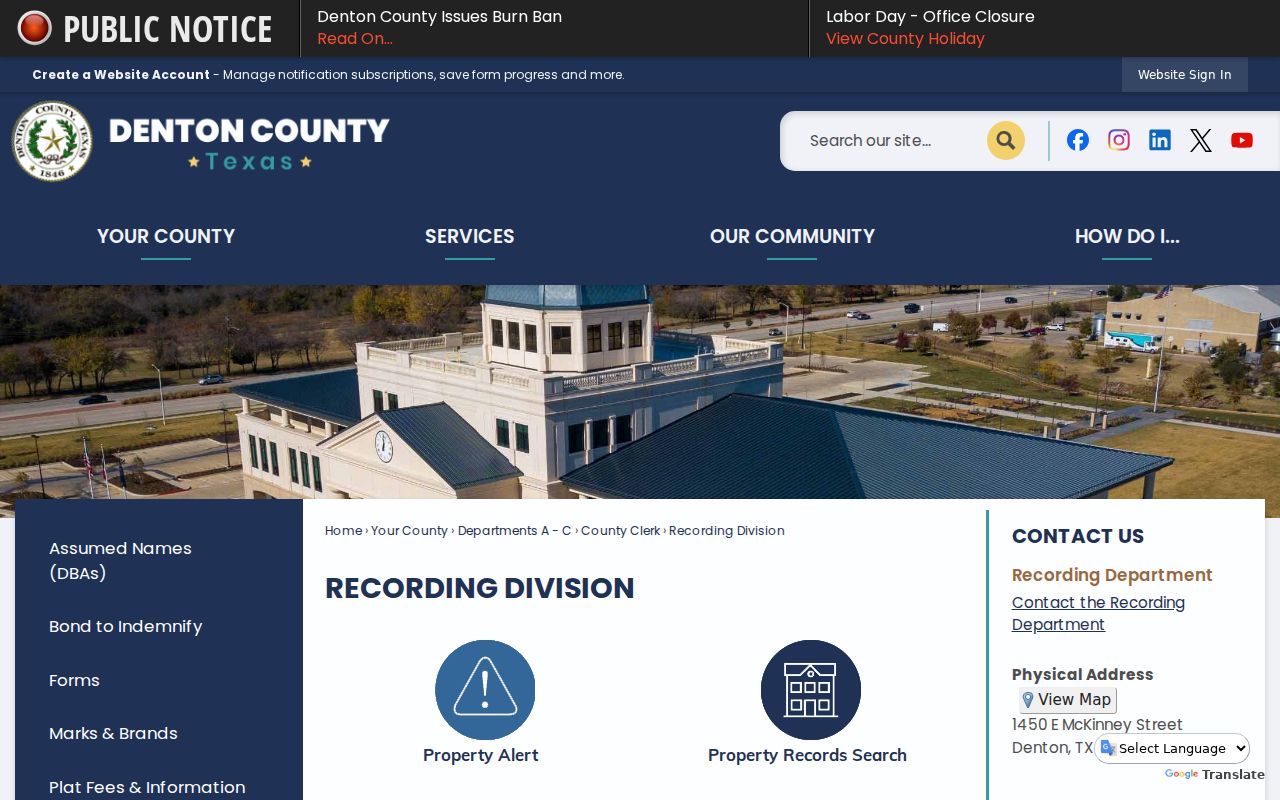
The recording office is at 1450 E McKinney St in Denton and is open Monday through Friday, 8:00 a.m. to 4:30 p.m. A specific copy request should identify the document title, filing date, preferred copy type, and delivery preference whenever possible.
Lewisville Past Residents Reel Gaps
Older Denton deeds have a documented archival path. TSLAC lists deed records for 1854-1855 and 1875-1902. Its direct indexes cover 1854-1855 and 1876-1895 on reel 1302133, then 1895-1903 on reel 1303134. Its reverse indexes cover 1876-1885 on reel 1303134 and 1895-1903 on reel 1302135. Those indexes let a researcher work both party directions when a street form does not resolve.
The gaps matter. Volume 61 is missing, and volumes 75 and 78 were not filmed because their entries extended beyond the project cutoff. A break at one of those volumes is a known limitation, not a reason to invent a transfer. Preserve the missing-volume note, then ask the Clerk or Research Room about the next available route. TSLAC also documents older marriage, probate, civil-minutes, naturalization, tax-roll, and poll-tax resources that can add a separate historical clue.
The Denton County Property Alert is a no-cost way to receive notice of future filings affecting a selected name or property.
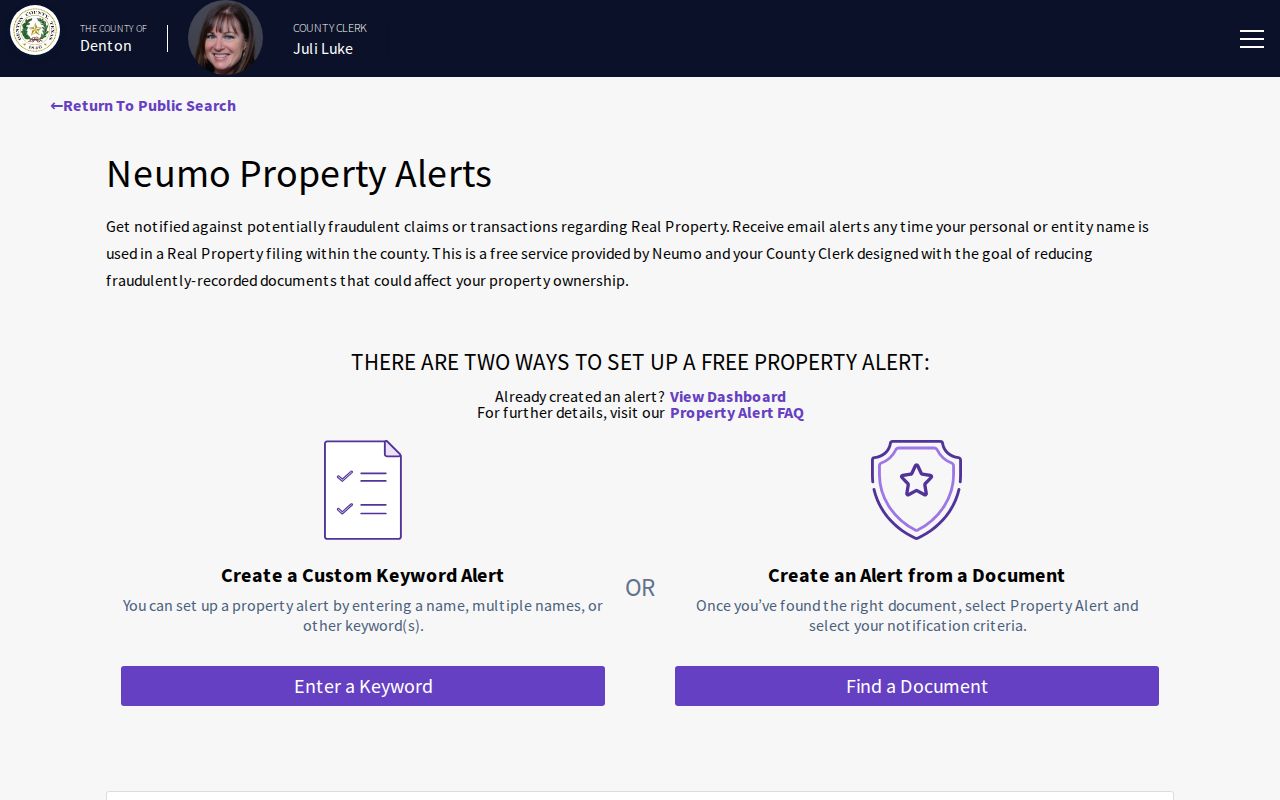
An alert watches later filings. It does not fill a historic deed gap or replace the recorded-instrument index, a Clerk copy, or the archival reels.
Lewisville Previous Residents Directory Pairing
Deeds identify a property relationship. Dated directories and census-era material can test whether a household connection is plausible. The Lewisville Public Library confirms city directories, oral histories, books, newspapers, and Denton County material in its Local History & Genealogy Collection, but it does not publish a complete directory-year list or reverse-directory run. HeritageQuest, available through the library for cardholders, offers city directories, maps, census resources, and primary sources.
- Record the directory title, year, publisher, page, printed name, and address or route exactly as shown.
- Inspect the scan, including abbreviations and punctuation, before copying OCR text.
- Compare the dated address form with the parcel legal description, a recorded instrument, and a map for that period.
- Pair a directory year with an appropriate census or poll-tax period, then note whether the address, precinct, or family details agree.
- Use newspaper, oral-history, probate, cemetery, or custodian-held material only as separately dated support.
The Portal’s 1956 Dallas directory sample contains Lewisville-area rural-route and box entries. Its h notation means home, while r marks room or residence notation. Those conventions make a directory line a dated lead, not a simple modern street address. The collections and access routes are handled in the Lewisville city directories.
Lewisville Historic Poll-Tax Clues
TSLAC’s Denton poll-tax payer list covers 1938-1947 and is alphabetized within precinct. A record can include a poll number, tax-receipt number, name, age, current address, length of residence in Texas and Denton County, citizenship, birthplace, and a historical occupation field. Entries can be incomplete. The record is a period-specific civic and family-history clue, not a present resident list.
Use the precinct and residence-duration fields to test a dated family trail, then seek independent confirmation in a directory, census, newspaper, map, or deed. A disagreement may expose a route address, a different place name, a move within the county, or an incomplete entry. Keep the original spelling and precinct rather than silently converting them into a current Lewisville address.
Note: A dated tax-list entry supports historical research only and should not be used to infer a living person’s current location.
Lewisville Historic Address Sanborn Context
Maps are best used to test address continuity before names are compared. The confirmed 1912 Lewisville Sanborn record can show a historic block, building footprint, property boundary, house or block number, construction materials, openings, water facilities, businesses, and fire notes.
The map helps orient a street or structure. It does not prove who occupied a building. Compare its sheet and date with road intersections, rail, schools, churches, cemeteries, or subdivision names, then return to the legal description and deed.
TSLAC also lists Lewisville maps for 1961, 1970, 1972, 1973, 1983, 1988, 1991, and 1992. No official street-renumbering schedule was located. A historic-number mismatch must therefore remain unresolved until a plat, road record, ordinance, deed description, or another custodian record supports a change.
Lewisville Address Confidence
Use a short evidence card for each person or property connection: address as printed, query date, PID or legal description, instrument number and date, exact indexed grantor and grantee, directory title and page, map sheet, source URL or reel, and an uncertainty note. A name found in a current owner field alone is weak historical evidence. A recorded transfer plus a dated directory line or map context is stronger, but each item still needs its own label.
Burial and obituary material can help close an older family trail, yet it has its own limits. The Denton County Research Room maintains a continuing Historical Commission record of county cemeteries and burials. Smith Cemetery’s history records 106 graves moved in 1951 because of Lewisville Lake construction. That relocation can explain why a burial place changes in a family search, but it does not establish where a person lived. The Research Room, library newspapers, and oral histories are the documented places to pursue that kind of historical question.
Lewisville Past Residents Household Limits
Lewisville previous residents research is a house-history exercise, not a way to construct a current household list. A parcel owner, a deed grantee, a directory entry, a poll-tax payer, and a burial record each prove different things. Protected addresses and confidential records must remain protected. Keep the custodian, record type, and date beside every name, and leave an item marked unresolved when the evidence does not converge.
Personal, lawful use. Use a Lewisville address history for genealogy, family history, estate questions, or personal property research. Do not use past-resident information to stalk, harass, intimidate, or harm anyone.